
The luxury digital marketing benchmark of 2,069 brands, by Affluent Audiences, found the top performers are not the most prestigious or the largest. Prestige buys almost nothing technical, and scale actively costs mobile experience. What the leaders share is a fast, findable, well-structured presence a phone and an AI model can both read.
Despite 76% of luxury e-commerce traffic being mobile, the finest brands in the world run below-average mobile experiences. Affluent Audiences’ benchmark of 2,069 luxury brands found only 31% of luxury brands pass Google’s mobile performance bar, against 48% of the web at large. Desktop is no rescue: luxury passes at 41% against 56% for the web, so the sector trails the global standard by at least 15 points on both.
When structuring high yielding digital marketing strategies, balancing a strong brand and a strong digital marketing presence is where the opportunity sits.
This benchmark compares Affluent Audiences’ proprietary audit of 2,069 luxury brands against reputable third-party global standards, including the HTTP Archive Web Almanac 2025
Which digital marketing strategies separate top-performing luxury brands?
The luxury brands with top performing digital marketing strategies are not the most awarded, the oldest, or the largest. We clustered 2,069 luxury brands, reducing more than 250 data points per brand to eight structural pillars. The brands that punched above their weight for awareness, engagement, discoverability, demand-generation and conversion shared one key trait: a site that loads fast, states clearly what it is, and exposes structured data that search engines and AI models can parse. Everything else varied widely.
That sounds obvious until you see how many prestigious names fail the bar. Recognition and technical quality are close to unrelated in our data. A brand can hold enormous cultural weight and still serve one of the slowest experiences in the set, with 69% failing Google’s mobile core web vitals. Even the best-performing luxury archetype fails to match the global average.
The larger the luxury brand, the worse it performs on mobile - Luxury Digital Marketing Benchmark of 2,069 brands, by Affluent Audiences

Tohru in der Schreiberei’s three Michelin-starred restaurant is one of the few rare leaders outperforming 99.2% of the luxury set for mobile speed and experience.

Tohru in der Schreiberei’s three Michelin-starred restaurant is in the top 1% of the luxury set for mobile speed and experience.
Does brand prestige drive online visibility and digital performance?
No. Prestige and mobile performance are statistically unrelated in our data. Prestige earns attention, links and searches. It does not earn a fast site, clean structure or online visibility in AI answers. Those are built, not inherited.
This is the first place brand teams misread their own position. They may assume standing in the physical world carries into the digital one. It does not transfer on its own. The name opens the door; the experience behind it is a separate build, often underfunded because it feels less glamorous than the campaign, yet vital to all campaign conversion.
One standout example of a small brand with excellent AI readability is Carl Friedrik luggage, with 3.5x the luxury median knowledge graph score, outscoring at least three larger, more established luggage brands on how clearly search engines and AI recognise it.
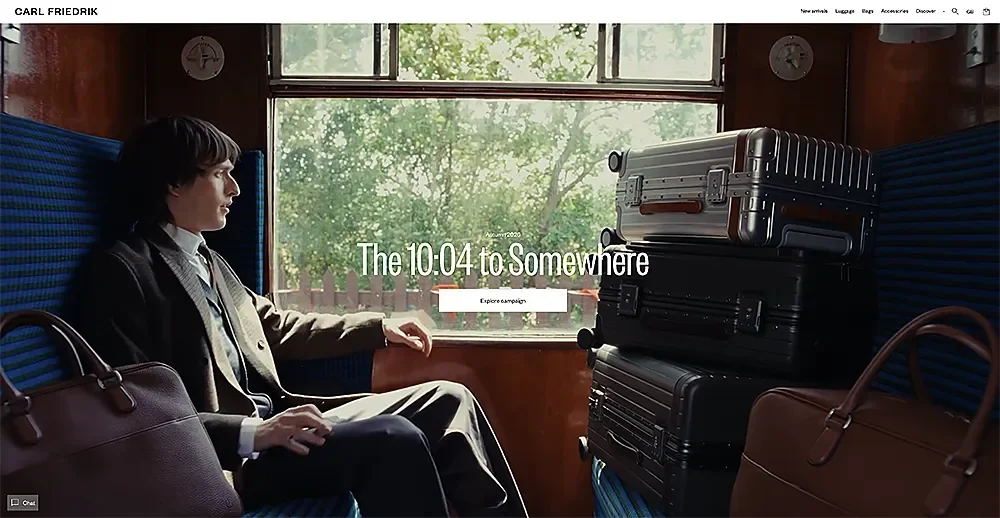
Carl Friedrik luggage has 3.5x the luxury median knowledge graph score
The practical consequence: the most prestigious competitor can be easily beaten in site performance and generative engine optimisation, because they may rely on a reputation that doesn’t translate into digital excellence and readability, without focused effort and prioritisation.
Prestige doesn’t produce better mobile experience - Luxury Digital Marketing Benchmark of 2,069 brands, by Affluent Audiences
How does brand scale impact overall brand visibility and AI readiness?
Scale cuts both ways. Larger brands earn more authority; size does bring links and recognition. But scale and mobile performance have an inverse relationship. The bigger the organisation, the slower the site tends to be, weighed down by tag managers, legacy platforms and committee-built pages.
Scale also buys no readiness for AI. The correlation between size and machine-readability is indistinguishable from zero. Being large does not make a brand easier for a model to cite. So the biggest names often hold the most authority and the worst experience at once. This provides an opening which a smaller, sharper competitor can exploit to gain citability, and market share.
As luxury brands grow, authority climbs but the site slips and AI readiness stalls - Luxury Digital Marketing Benchmark of 2,069 brands, by Affluent Audiences
One large house in our set breaks the pattern on every count: Bottega Veneta stays fast, highly visible in branded search and cleanly readable to AI at scale, and revenue has kept growing while much of its sector contracted. Size did not dull its digital performance, even in a down market. That is a choice, not an accident, and a rare one.
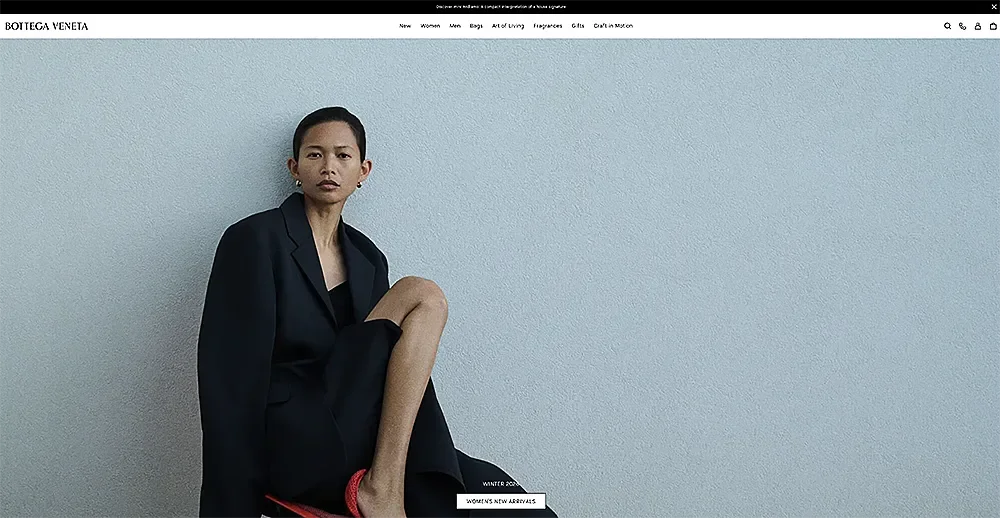
Bottega Veneta is fast, highly visible in branded search and cleanly readable to AI at scale.
What is a good conversion rate for a luxury e-commerce experience?
A good conversion rate for a luxury ecommerce experience typically ranges between 0.7% and 1.19% (less than half of the broader 2.5% to 3.0% retail average). Luxury executives have long accepted that high basket value and longer consideration cycles naturally suppress baseline conversion rates. However our new data suggests that inferior luxury mobile experience correlates significantly with conversion lag, and that luxury brands must prioritise the elimination of fixable performance issues to maximise e-commerce revenue.
Luxury converts at a third of the broad rate — and worst on mobile
Our data shows that half of luxury brands offer a phone experience no faster than the web-wide average, despite three very important considerations from 3rd party studies:
Luxury consumers are the most speed-sensitive of any sector studied: a 0.1-second improvement in mobile speed drove a 40.1% jump in luxury shoppers moving from product page to basket (Google/Deloitte).
76% of luxury shopping browsing is on mobile, where conversion is worst (Dataintelo|CUFinder)
Ecommerce buyers are at their most speed sensitive, at the decision moment (Harvard Business School).
Luxury shoppers punish slowness hardest
Considering this holistically, we can start to understand why mobile pulls 76% of luxury ecommerce browsing but only 58% of sales. The shortfall is the mobile conversion leak at work.
Luxury has always traded on the idea that the best things are worth waiting for, and that’s true for a bespoke commission, a hand-finished piece made to spec, or a couture fitting. But a slow-loading web page is not craftsmanship the customer chose to wait for; it is friction they didn’t ask for, at the exact moment they were ready to act. Patience for the atelier does not extend to the loading bar.
“A bespoke commission or a couture fitting is craftsmanship worth waiting for. A slow loading mobile site is friction the customer didn’t ask for, at the very moment they were ready to act”
How should CMOs balance brand awareness against digital execution?
For luxury CMOs to deploy their budget to the greatest effect, they need to generate just a little more demand than they can supply, and fulfil it with a smooth customer experience at the point of sale. Yet, more than half of the 2,069 luxury brands we analysed, over-reach and underdeliver, or over-engineer and under-reach.
Our benchmark combines over 250 metrics per brand, but the balanced luxury sector median comes down to four numbers:
6,600 branded searches a month
17,600 organic visits
75 referring domains
50 mobile performance on Google’s scale
A quarterly KPI review should show equilibrium. If you find your pendulum swinging above the luxury average on one KPI, and below on another, it’s time to recalibrate.
If we had to pick one exemplar case of a brand with a well balanced marketing strategy, based on the data we analysed, it would be Johnstons of Elgin. This family-owned and profitable B-corp brand has built a digital presence where every part pulls its weight. Its demand, its site experience, and its authority all sit comfortably above the luxury benchmark, and none of them race ahead while the others lag.
The result is a brand that is easy to find, easy to trust, and easy for both people and search engines to understand. Growth like this comes from knowing which levers to pull, in what order, and when to stop pushing one and start building another. A part-time CMO can provide the senior judgement to keep a capable team on track.

How can a luxury CMO measure their own brand’s digital performance?
The luxury digital marketing benchmark of 2,069 brands, segments cleanly into four performance quadrants, with only 22% of brands performing above the luxury median for both awareness and site performance. The first step for a luxury brand CMO is to identify in which quadrant they reside.
In which quadrant does your brand sit? - Luxury Digital Marketing Benchmark of 2,069 brands, by Affluent Audiences
How to improve a luxury brand’s online visibility
All brands start in the bottom left quadrant, barely built and hardly known. The goal is to move upwards, quietly excellent and then migrate over to aligned leader in a faster timeframe than the competition. However, by our luxury digital marketing benchmark data, 28% of luxury brands have taken the wrong route, or failed to review their digital excellence after a period of degradation, placing them in the leaky zone where expensive awareness converts into business for a competitor brand at the decision moment.
| Step | The order of aligned leaders | The order of leaky brands |
|---|---|---|
| 1 | Brand identity and positioning | Chase fame |
| 2 | Fast, clear website | Buy awareness |
| 3 | Findable by machines | Notice leakage |
| 4 | Earn authority + citations | Fix site issues |
| 5 | Amplify: social + paid | Build findability |
However, the exemplars prove it can be done. You can carry the imagery, the film and the storytelling that luxury demands, and still load fast, read cleanly to both people and machines, and command real authority and demand. Beauty and performance are not a trade-off. They are a build.
There’s no excuse anymore. The standard is known, the benchmark is set, and the aligned leaders have shown the way into their quadrant.
Discover where your brand sits
Affluent Audiences is a marketing agency for luxury brands, book a diagnostic call with our specialists.


Sources
Proprietary data is from the Affluent Audiences Luxury Digital Benchmark, an audit of 2,069 luxury brands across 250+ signals per brand (August 2026).
Third-party figures are cited below.
Site performance: Luxury mobile Core Web Vitals pass rate 31% versus 48% globally; desktop 41% versus 56%. Global figures: HTTP Archive Web Almanac published Jan 2026, Performance chapter.
Correlations (proprietary, n=2,069). Prestige to mobile performance, r=0.05. Scale to authority, r=0.74 (log scale). Scale to mobile performance, r=−0.24. Scale to AI readiness, r=0.02.
Speed and conversion (2020). A 0.1-second mobile speed improvement drove a 40.1% uplift in product-detail-to-basket progression for luxury, the highest of any sector studied. Google and Deloitte, "Milliseconds Make Millions", based on 2.1m luxury sessions across 10 brands.
Luxury conversion rates (2025/2026). Luxury and jewellery average 0.70%–1.19% versus 2.50%–2.96% for broad retail. Dynamic Yield, Global eCommerce Benchmarks.
Mobile share (2025/2026). Mobile accounts for 58% of luxury ecommerce sales (72% in APAC), Dataintelo Luxury E-commerce Market Research Report, supported by Bain & Company (>60% of luxury purchases involve mobile touchpoints). Mobile accounts for 76% of luxury ecommerce traffic, CUFinder aggregate.
Brand homepage screenshots are reproduced for criticism and review under fair dealing (UK/EU) and fair use (US), attributed to their owners. All trade marks and imagery remain the property of their respective owners; no affiliation or endorsement is implied.