The 80/20 principle in marketing: A leadership framework for luxury CMOs
This is for marketing leaders who find themselves correcting, reworking and rescuing — whether that is their team’s or an AI’s contributions. It introduces the 80/20 Pareto principle in marketing leadership, to protect a CMO’s time while raising the quality of their team’s input and initiative. Includes a downloadable Clarity Grid to reset the standard with intention, every Monday morning.
Originally published by Niki McMorrough, 11 December 2025. Reviewed and updated 1 May 2026 — expanded to cover AI direction alongside team leadership.

Luxury CMOs: identify your ‘vital few’ each week.
How does an open door policy slow a CMO down?
If every unpolished thought your team has can reach your desk, you are training them that any input — no matter how unfinished — will get a result. You are rewarding the frantic and the noisy with your most valuable asset: your attention.
A maison is not controlled, it is curated. The door may be open, but there must be a velvet rope across it. If you find yourself correcting spelling, verifying data, or polishing half-baked ideas, you are not leading — you are compensating. And that is a habit that stunts your best people, because it teaches them their unpolished efforts are good enough to reach the executive desk.
What should a minimum quality standard look like?
The instinct is to demand people get it right first time. This breeds paralysis, not excellence, because it conflates perfection with quality.
The better standard is: do your best, and check it twice.
This acknowledges that good work is iterative — but it refuses to accept work that falls below what someone is already capable of. There is a difference between work that needs refinement and work that needs rescuing. Your job is to accept the former and return the latter.
How do two knockbacks produce better work?
Once you set a standard, you need a way to hold it without becoming someone your team fears. The two knockbacks is a simple method. When a team member submits work that is beneath their capability, you return it — twice if needed, with a clear reason each time.
| Knockback | What you say |
|---|---|
| First | “This feels unfinished. Please review it against our brand standards and resubmit.” |
| Second | “I can still see the seams. Polish it once more.” |
The goal is not anger. It is to make your approval worth something. When your team knows that good enough comes back, they start to self-edit before it reaches you. Your yes becomes a mark of quality rather than a rubber stamp.
It’s a healthy sign if your team starts asking “would this get past the rope?” before they send anything.
Does the two knockbacks work with AI as well as people?
Yes - and this is where the framework has taken on new relevance. Directing AI well is a leadership skill. The same instinct that makes a CMO accept a half-finished brief from a junior is the instinct that accepts a plausible but shallow AI output and publishes it.
Two knockbacks work exceptionally well with a language model. A first-pass AI draft is rarely the best that model can produce. Return it with a specific instruction — “this is too generic, rewrite it for a high-net-worth audience at a private jewellery salon”— and you get a better output. Return it a second time with an even tighter brief, and you get something genuinely usable.
The underlying principle is the same: accepting the first output trains the system — human or AI — that the first output is sufficient.
How does the 80/20 principle in marketing leadership work in practice?
The Pareto Principle holds that 80% of outcomes come from 20% of inputs. Applied to your working week, most of your strategic impact comes from a small number of decisions — your Vital Few. Everything else is noise.
The Clarity Grid is a one-page weekly planning tool for identifying those initiatives and protecting them. It enforces three standards:
| Standard | What it means in practice |
|---|---|
| Vital few | If it does not serve your core strategy, it stays behind the rope |
| Deliberate delegation | Name the person who owns each piece of execution. If you cannot, you are hoarding responsibility |
| Strategic no | A polite refusal signals that your ‘yes’ has real value |
Used on a Monday morning, the grid shifts your week from reactive to deliberate. You stop fixing and start accelerating the work that moves the brand.
If your Vital Few audit reveals that your team is buried in execution, that is the signal. It may be time to bring in a specialist partner to create the capacity for the work that matters.
Download the Clarity Grid
Fill in the form below to receive the Monday Morning Clarity Grid — a one-page weekly planning tool for luxury marketing leaders.
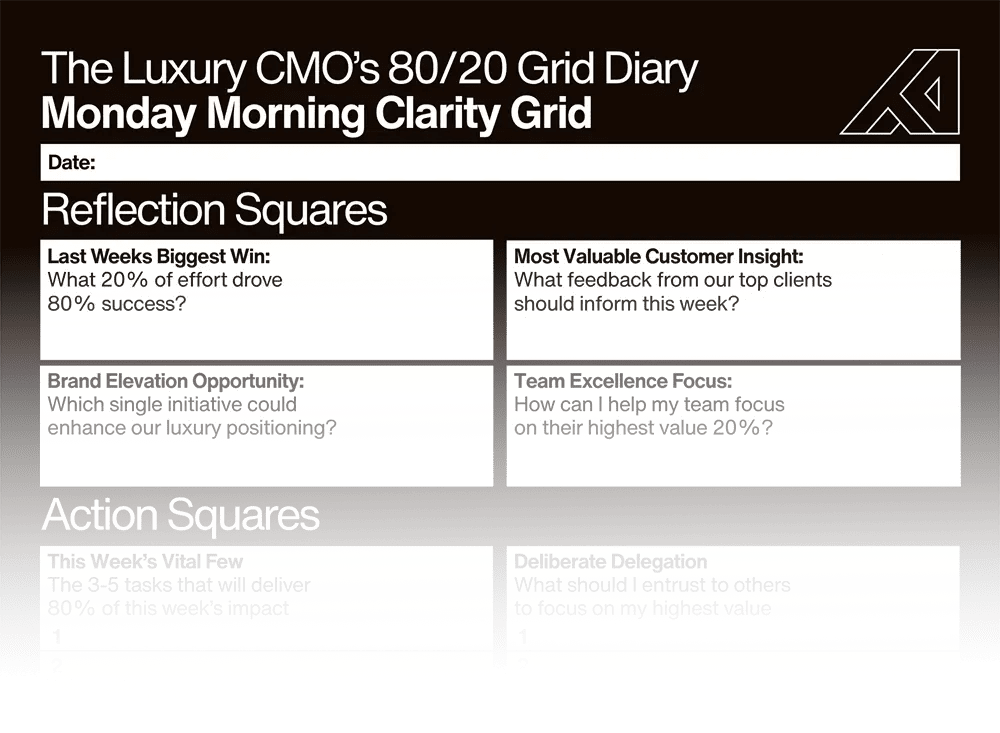
Fill the form below to receive the Monday morning clarity grid, and start instilling excellence.
-
-
When the gap is too wide to close from the inside. If work is still coming back after two knockbacks, that is not a performance issue — it is a skills or capacity issue, and it needs a different solution. Let’s talk about how our head, heart, hands approach could support your team.
-
Luxury and premium brands at an inflection point — a rebrand, a new market, a team that has grown faster than its standards. We work alongside your existing structure, not instead of it. If the brief involves an affluent audience and a high bar, we are likely a fit. Tell us about your brief.
-
Rather than carrying the overhead of a large agency, we draw on 30 years of senior partnership and a creative collective of specialists — assembled for your brief. That means direct access to the people who have worked on and in Bentley, La Prairie, Diriyah and the Olympics (VIP). All good things start with a conversation. Let’s talk.